
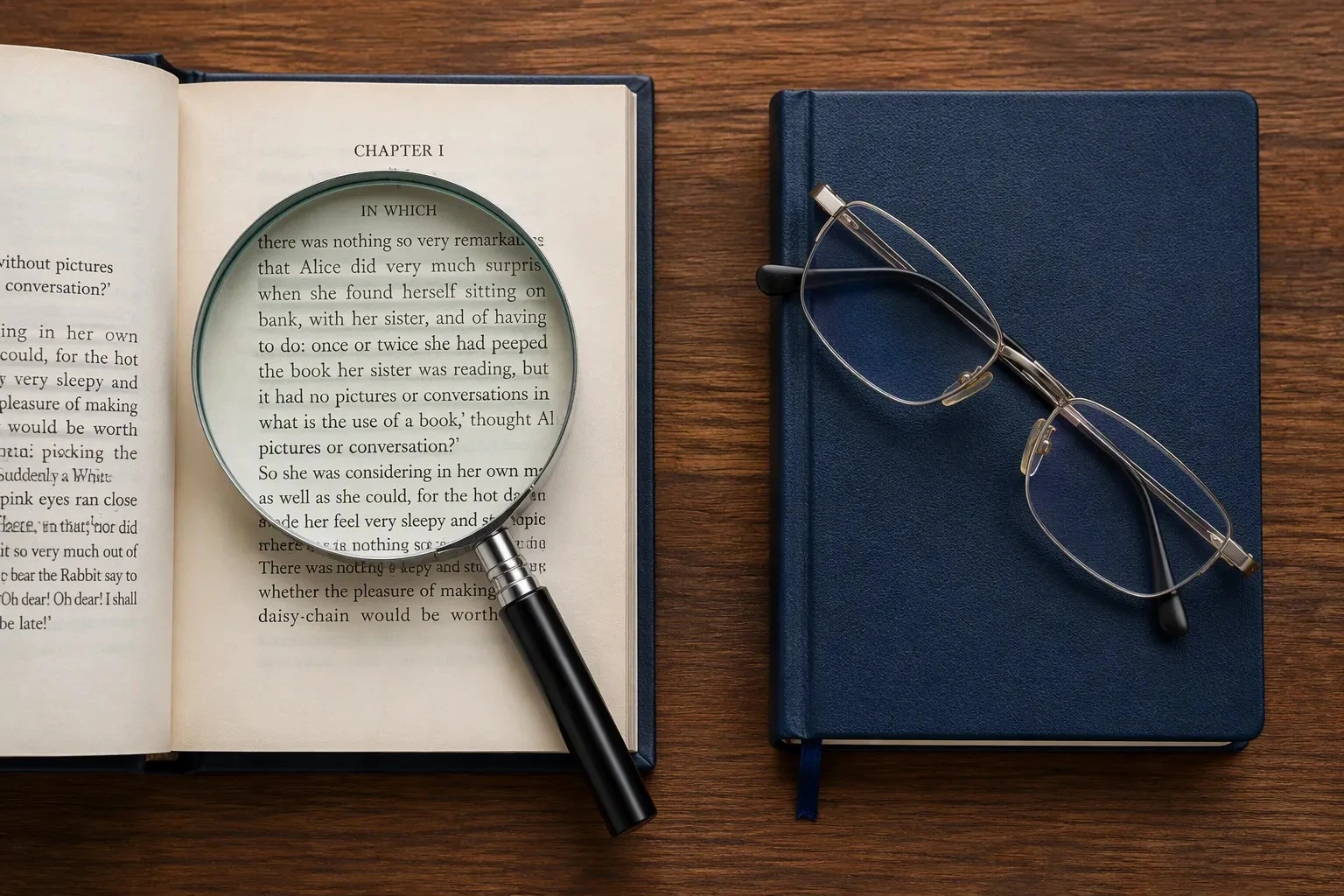
Reading Magnifying Glass vs Reading Glasses
A reading magnifying glass is better for quick tasks or close-up details while reading glasses usually work best for long reading sessions. If small print looks blurry now, or your eyes get tired when you read a book, you are not alone. According to The Vision Council, about 13.2 percent of Americans—34.5 million people—use over-the-counter reading glasses, and most are over 45. The same frustration hits hobbyists threading needles or sorting stamps. Here is the key point: reading glasses fix your focus. They do not just make the image bigger. That difference shapes everything. Optical design, field of view and lighting, comfort and fit, and cost and accessibility each play a role. This guide helps you match the tool to your task.
Key Takeaways
- Reading glasses fix your focus so you can read comfortably for a long time.
- A reading magnifying glass makes the image bigger for quick, close-up tasks.
- Pick reading glasses for reading chapter after chapter and for use without your hands.
- Choose a magnifying glass for hobbies, reading labels, or places with low light.
- Choose the right tool for the job: glasses for distance, magnifiers for close-up detail.
- Check your reading strength with a chart or age guide to find the right fit for you.
- Think about using a lighted magnifier for dark corners and small details.
- Put your money where you read the most: sturdy readers for everyday use, simple magnifiers for times you only need one now and then.
Optical Design Compared
Lens Type and Power
The two tools look similar on a store shelf. Their lenses work in very different ways.
Readers: Fixed Strengths
Reading glasses use a positive meniscus lens. This curved shape bends light so your eye can focus on close objects. You buy readers in fixed strengths, and each strength matches a specific focusing distance. The label on the frame tells you that strength. A higher number does not mean a bigger image. It means the lens focuses at a shorter distance.
Magnifiers: Enlargement Only
A reading magnifying glass usually carries a bi-convex lens in handheld, loupe, pendant, pocket, or keychain form. Bar and dome models use a plano-convex lens instead. These lenses are strong. Their power equals roughly 1000 to 2000 degrees, which is far too strong for anyone to wear all day. That is why you use them for short-term or special-occasion tasks only.
| Attribute | Reading Magnifying Glass | Reading Glasses |
|---|---|---|
| Lens type | Bi-convex (handheld, loupe, pendant, pocket, keychain) or plano-convex (bar, dome) | Positive meniscus |
| Power | Roughly 1000–2000 degrees, too strong for individuals | Prescribed in appropriate, wearable strengths |
| Suitability | Short-term or special-occasion use | Regular wear after a professional eye exam |
Focus vs Enlargement
How Readers Correct Near Vision
Here is the misconception to clear up. Reading glasses do magnify a little, but their real job is precision. They correct your focus. When small print looks blurry, your eye is struggling to bend light onto the right spot. A reader fixes that bend. Choosing a strength is about finding the right focus for your eyes, not about magnification power. People also call these glasses readers, cheaters, and magnifiers, which adds to the confusion. Prescription reading glasses may serve some people better than off-the-shelf pairs, because an exam pins down your exact needs.
What a Magnifier Actually Does
A magnifying lens simply makes things appear larger. It multiplies image size. It does not correct your vision. You move the lens closer or farther until the image sharpens, and your eye does the rest. Some magnifying glasses accept more than one lens at a time. People typically use those stacked-lens models for small work like art, jewelry, or watch repair. The extra lens adds power for tiny details, not for reading a novel.
Best Fit for Each
Everyday Reading
For everyday reading, readers win on design alone. The positive meniscus lens sits at a comfortable distance from the page. The fixed strength matches a typical reading distance. You wear them and forget them. A magnifier forces you to hold a strong lens at a precise spot, and that gets old fast.
Fine Detail Work
For fine detail work, the magnifier's design shines. The strong bi-convex or plano-convex lens delivers the enlargement you need for a single stamp, a stitch, or a watch gear. You bring the tool to the task, study the detail, and set it down. The high power that makes these lenses unwearable also makes them perfect for short bursts of close inspection.
The design difference comes down to one idea. Readers adjust focus for steady wear. A reading magnifying glass enlarges the image for brief, targeted looks. Match the lens to the length of your task, and both tools serve you well.
 on the left is a handheld magnifying glass with a black handle. On the right are a pair of tortoiseshell-patterned reading glasses
 reading magnifying glass that makes these lenses unwearable also makes them perfect for short bursts of close inspection of the stamps or painting in a gallery
 An old lady wears a reading glasses for everyday reading, readers win on design alone sits at a comfortable distance from the page.


Reading Magnifying Glass: Field of View and Lighting
Text Visible at Once
A reading magnifying glass for reading does not need high magnification power. That low power lets the lens stay relatively large. A big lens shows more of the page at once. You spend less time sliding the tool around to find the next word.
Page Coverage With Readers
Reading glasses work differently. They sharpen close vision and add comfort at reading distance. They do not multiply image size. Each lens gives you a small viewing circle. You see the page through two small circles, and your eyes stitch the rest together. The glasses stay on your face, so your hands stay free. The trade-off is simple. You gain convenience and lose nothing in clarity, but the image itself stays the same size.
The Keyhole Effect
Magnifiers bring their own viewing quirk. Eye care professionals call it the keyhole effect. The closer you get to a keyhole, the more you can see out of it. A magnifier works in reverse. The closer your eye sits to the lens, the more your field of view shrinks. You see only part of the full magnified image. A large lens or a wide field of view lens helps here. It lets more text stay visible at once, so you do not have to move the magnifier constantly. Some rectangular designs push the field even wider.
| Attribute | Reading Magnifying Glass | Reading Glasses |
|---|---|---|
| Lens size | Relatively large lens | Small lenses |
| Field of view | Larger field of view; some rectangular designs further enlarge it | Two small circles |
| Lighting requirement | Can include LED or illuminated options for dark environments | Works only in bright environments |
Lighting Demands
Magnifiers With Built-In Lights
Light changes the game for magnifiers. A built-in light system provides a greater level of detail and makes reading easier in dark environments. An LED magnifier aims light straight at the page. That difference shows up in dim restaurants, poorly lit kitchens, and at bedtime. A self-lit handheld magnifier lets you read a menu without asking for help. One switch turns the LEDs on. Many LEDs mean you do not depend on a distant room lamp. Lighted magnifiers can also ease eye strain, fatigue, and headaches from low-light reading. LED bulbs run cool, sip battery power, and last roughly 100,000 hours, about 30 to 40 years of regular use. Quality LEDs spread a broad, even glow instead of a narrow spotlight. That even coverage is what makes reading comfortable.
Readers and Room Lighting
Readers carry no light of their own. They perform only in bright environments. You need a good lamp, a window, or overhead light. In a dim room, a pair of readers cannot rescue blurry print. Plan your reading spot around the light, and readers serve you fine.
Best Uses for Each
Books and Long Articles
For books and long articles, readers hold the advantage. The wide page coverage comes from your own eyes, not a lens you must hold. You can read for an hour without repositioning a tool. A page magnifier or full-page stand can help with a whole page at once, yet most readers still prefer glasses for chapter after chapter.
Labels and Hobbies
Short, targeted looks favor the magnifier. Reading a pill bottle, a serial number, or a care tag takes seconds. Hobbies fit the same pattern. A stamp collector studies one square. A seamstress checks one stitch. The built-in light helps in a dim corner of the workshop. You bring the lens to the detail, inspect it, and set it down.
Field of view and lighting point to a clear split. Readers give steady coverage under good light. A reading magnifying glass trades page coverage for enlargement and often brings its own light. Choose based on how much text you need to see and how bright your room is.
Comfort and Fit
Wearing vs Holding
Hands-Free With Readers
Readers sit on your face, so both hands stay free. You can hold a book with one hand and turn pages with the other. Your neck stays in a natural position. This setup matters for long sessions. You simply look down at the page and read.
Hand Fatigue With Magnifiers
A handheld magnifier asks more of your body. Extended reading with a handheld magnifier can strain your neck, shoulders, and hands. Lightweight, easy-to-grip handles and contoured grips improve control and reduce fatigue. Hold the lens about 2 to 3 inches from the text for best clarity. Experiment with that distance until your eyes feel comfortable.
Fit and Adjustment
Finding the Right Power
Readers come in fixed strengths, and the right one depends on your age and task. Typical starting points look like this:
| Age Range | Typical Reading Glasses Strength (diopters) |
|---|---|
| 40–49 | +0.75 to +1.50 |
| 50–59 | +1.50 to +2.25 |
| 60 and up | +2.25 to +2.75 |
You can also test yourself with a printed strength chart. Hold it roughly 14 inches from your face, cover one eye, and read down the lines. Note the diopter beside the smallest line you read clearly. Repeat with the other eye. If two strengths feel similar, pick the lower power to reduce eye strain.
Stand and Full-Page Options
A stand magnifier or full-page model removes the holding problem. The stand rests on the page and keeps the lens at a set height. You slide it down the column instead of lifting it. These options suit readers who want enlargement without arm strain.
Longer Reading Sessions
Bed and Couch Reading
Soft seating changes the math. You recline, and the page sits farther from your eyes. Readers handle this shift well. A reading magnifying glass becomes awkward in bed, because you must hold it at the right angle against gravity. A lighted stand model works better for occasional couch use.
Short Bursts vs Extended Use
Match the tool to the duration. A magnifier shines for a quick label check or a single stitch. Readers win for chapter after chapter. If headaches or eye strain appear, recheck your magnification needs.
Reading Magnifying Glass vs Reading Glasses: Cost and Access
Price Ranges
Over-the-Counter Readers
When near vision starts to fade, most people reach for an off-the-shelf pair of readers or a magnifier to sharpen the blur. Over-the-counter readers sit at the low end of the cost scale. You pick a strength from a rack, pay once, and walk out. Basic plastic frames cost the least. Metal frames and spring hinges push the price up a little. Neither option requires an appointment or a prescription.
Prescription and Specialty Options
Prescription reading glasses cost more than off-the-shelf pairs. The exam fee, the lenses, and the frame all add to the total. Handheld magnifiers land in a middle range. Simple pocket models cost very little. Lighted models and wide-field designs cost more, and stand or full-page magnifiers sit at the top of the magnifier range. Each option earns its price in a different setting.
Buying and Trying
Drugstore and Online
Drugstores let you try readers on the spot. You can hold a page at arm's length and test a few strengths in minutes. Online stores offer wider frame choices and often lower prices. The catch is that you cannot test the fit. Order from a seller with a clear return policy, and check the strength chart before you buy.
When an Eye Exam Helps
An eye exam helps when your two eyes need different strengths, when blurry vision persists, or when headaches appear during reading. A professional can spot other vision changes that a drugstore pair cannot fix. For a reading magnifying glass, no exam is needed. You simply match the lens to the detail work in front of you.
Value Over Time
Durability and Replacement
Readers take daily wear. Hinges loosen, lenses scratch, and frames bend. Cheap pairs may need replacing within a year or two. A sturdier frame lasts longer and often costs less per year of use. Magnifiers face less daily handling. A quality lens with a solid handle can serve for many years, especially a stand model that stays on a desk.
Matching Cost to Reading Habits
Match your spending to your habits. A daily reader who spends hours with books gets strong value from a durable pair or a prescription. An occasional user who checks labels and reads short notes does fine with an inexpensive pair. A hobbyist who inspects stamps or stitches gains real value from a lighted magnifier. Spend where you read most, and keep the rest simple.
Reading glasses work well for reading that lasts a long time. A reading magnifying glass is good for tasks you do now and then that focus on small details. The design shows the same thing: readers fix your focus so you can wear them steadily, while magnifiers make the image bigger for a quick look. Field of view and lighting favor readers when the light is good and magnifiers in dark corners. Comfort favors hands-free readers for long sessions and handheld tools for quick looks. Cost follows your habits, so spend where you read the most. Remember the main difference: readers fix focus, and magnifiers make things bigger. Schedule an eye exam if your vision changes or reading becomes uncomfortable.
FAQ
Do reading glasses actually magnify text?
They magnify only slightly. Their real job is to correct your focus. A positive meniscus lens bends light so your eye can lock onto close objects. Choosing a strength means finding the right focus for your eyes, not picking a magnification power.
What is the keyhole effect with a magnifier?
Your field of view shrinks as your eye moves closer to the lens. You see only part of the full magnified image. A large lens or a wide-field design keeps more text visible, so you slide the magnifier around less.
Can I wear a reading magnifying glass like glasses?
No. Magnifier lenses run roughly 1000 to 2000 degrees, which is far too strong for all-day wear. Use them for short-term or special-occasion tasks. Readers come in wearable strengths instead.
How do I pick my reader strength?
Start with your age range. Ages 40 to 49 typically fit +0.75 to +1.50. Ages 50 to 59 fit +1.50 to +2.25. Ages 60 and up fit +2.25 to +2.75. You can also test with a printed strength chart held about 14 inches away.
How far should I hold a handheld magnifier from the page?
Hold the lens about 2 to 3 inches from the text. Adjust that distance until your eyes feel comfortable. A lightweight, contoured grip reduces hand fatigue during longer looks.
Do I need an eye exam before buying readers?
Not always. An exam helps when your two eyes need different strengths, when blurry vision persists, or when headaches appear during reading. A professional can also catch other vision changes a drugstore pair cannot fix.
Which tool suits which task?
| Task | Better Fit |
|---|---|
| Chapter-after-chapter reading | Reading glasses |
| Reading in a dim room | Lighted magnifier |
| Pill bottles and serial numbers | Handheld magnifier |
| Stamps, stitches, watch repair | Magnifier, including stacked-lens models |
| Bed and couch reading | Reading glasses |