
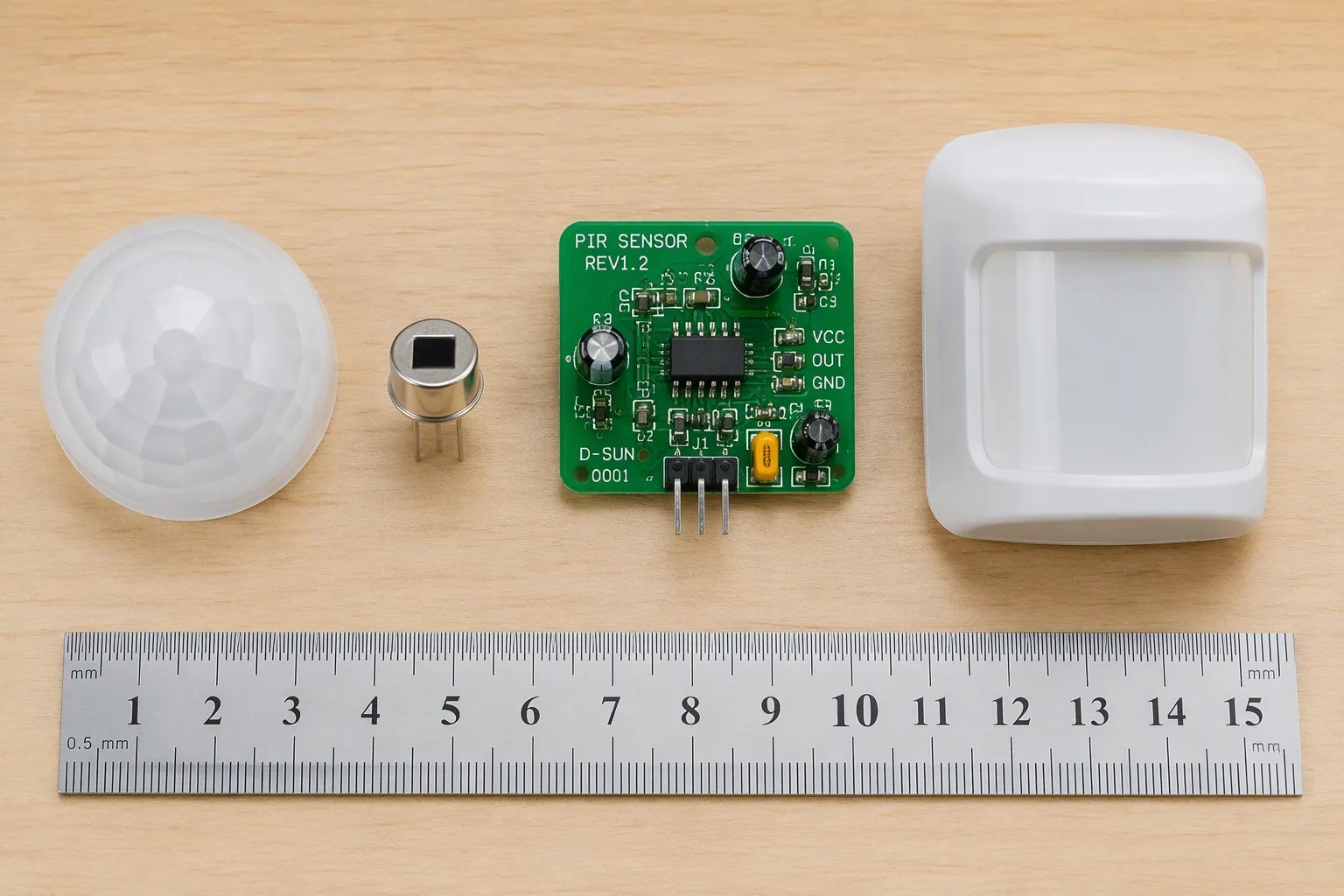
How a Fresnel Lens Works in a PIR Motion Sensor | The Simple Guide
A Fresnel lens works in a PIR motion sensor by focusing and splitting infrared light across multiple detection zones. This design lets the sensor cover a wide area while still catching small changes in heat.
Think of a magnifying glass concentrating sunlight into a bright spot. The lens in your PIR sensor does something similar with invisible heat rays. It gathers infrared energy and bends it toward a tiny sensing element inside.
You will learn how the sensor detects heat, why a bare PIR needs help, and how the PIR sensor lens and sensor team up. Each part plays a role in reliable motion detection.
Key Takeaways
- A PIR sensor picks up heat changes, not motion directly.
- A Fresnel lens collects infrared light coming from a large area.
- The lens breaks the view into many detection zones.
- Two sensors inside cancel out steady heat signals.
- A warm body that moves creates a differential signal.
- The lens covers a wide area and detects small movements.
- A JFET boosts the weak sensor signal for the circuit.
- Together, the lens and sensor allow for dependable motion detection.
How a PIR Motion Sensor Senses Heat
What "Passive Infrared" Means
The most important clue about this device is hidden in the word passive. A passive infrared (PIR) sensor does not give off any energy of its own. It only listens for heat that other objects give off. Engineers call this a pyroelectric ("passive") infrared sensor design because the sensing material produces a small charge when its temperature changes.
Active infrared sensors do the opposite. They send out a beam and watch for something to break it. A PIR device just stays quiet and waits. That difference is why passive infrared systems need so little power and work well in battery-powered gadgets.
| Feature | Active Infrared Sensors | Passive Infrared Sensors (PIR) |
|---|---|---|
| Emission | Emit infrared beams | Do not emit any radiation |
| Detection mechanism | Measure reflection of emitted beams | Detect changes in infrared radiation |
| Best use environment | Controlled environments | Diverse environments |
Human skin gives off strong heat in a narrow range. The table below shows how a PIR filter matches that range.
| Human-body IR peak | PIR sensor filter passband |
|---|---|
| about 9–10 μm | about 7–10 μm |
The Two Halves Inside
Inside each PIR sensing element are two detector slots. Makers cut these slots from a material that is sensitive to IR, usually silicon with a special coating. One slot sends a positive output. The other sends a negative output. Think of them as two balanced sensors placed back to back.
When nothing changes, both slots get the same amount of background infrared radiation. Their signals cancel each other out. The output stays flat and quiet. That balance is the key to the design.
Change, Not Motion
A pyroelectric crystal makes charge only when its temperature changes. Hold a steady heat source in front of it, and nothing happens after the first moment. The sensor ignores absolute temperature. It cares about difference.
When you walk past the sensor, your body crosses one slot first. The first slot sees a sudden jump in IR. The second slot still sees the normal background level. That difference makes a positive pulse. When you leave, the opposite happens and a negative pulse appears. The sensor reads these pulses as motion. If the whole room warms up slowly and evenly, both halves change equally. Their signals cancel, so no trigger fires. This is why a PIR device reacts to a moving person but not to a warm wall.
Meet Codex in the desktop app A coding agent that helps you build and ship with AI, included for free in your ChatGPT plan. Download the app Learn moreWhy a Bare PIR Sensor Needs a Lens
The Tiny Window Problem
The pyroelectric element inside a PIR sensor is very small. Its sensing window is tiny. That small opening can only gather infrared light from a very narrow angle right in front of it. Picture yourself looking at a wide room through a drinking straw. You would see just a thin slice of everything around you.
A bare element with no optics has a serious problem. It cannot pull in heat from a wide area. If someone walks off to the side, the sensor will never see them. The element alone cannot gather those rays at all. This issue is the tiny window problem, and it shapes every design choice that follows.
A Generic Sensor With No Direction
The pyroelectric element itself has no natural sense of direction. It does not know where heat comes from. It only reports that some infrared energy hit its surface. Makers build these elements as generic components. They have no set range, no viewing angle, and no spatial sense.
The optics are what shape the sensor's reach. Without them, the element responds to whatever heat happens to fall on its small face. It cannot tell left from right or near from far. Engineers solve this problem by adding a lens that gives the element structure and direction. The optics turn a blind heat detector into a device that knows where to look.
Why the PIR Sensor Lens Is Essential
A PIR sensor lens is not an extra add-on. It is a required part of every practical design. Without it, the sensor sees only a small slice of the room. A person could walk past the edge of that slice and never set off the sensor. The device would fail at its only job.
The lens fixes this by pulling in infrared light from a wide field of view. It sends those rays toward the small pyroelectric element. This is how PIR sensors get the wide coverage people want from motion lights and alarms. The lens also breaks the view into zones, which helps the element sense movement instead of steady heat. Every dependable PIR device relies on this teamwork between optics and sensing element. Without the lens, you lose the broad, reliable detection that makes these sensors work well.
How a Fresnel Lens Condenses IR Light
What Makes Fresnel Different
A standard lens uses one smooth, continuous curve to bend light. A Fresnel lens takes a different path. It swaps that thick curve for a flat surface covered in stepped rings. This design change matters for your PIR sensor lens because it keeps the optic thin and light.
Material choice is also very important. Makers form these lenses from an infrared-transmissive plastic. That plastic lets infrared light pass through instead of blocking it. One common option is Poly FIR200, a polyethylene-based polymer from Fresnel Factory's Poly FIR line. It targets the 8–14 µm thermal infrared band used by PIR motion sensing. Some references show the same band as 8–13 µm instead. The manufacturer specifies no numerical infrared transmission percentage. So makers have to pick the plastic based on operating wavelength and required transmission.
A traditional lens for this job would need thick glass. That glass is heavy and bulky. A Fresnel lens stays thin, often only 1–5 mm thick. A regular lens with a large aperture can be 10–100 mm thick. That difference makes a big impact in a small motion detector.
Concentric Grooves as Refraction Sources
The secret of a Fresnel lens lies in its surface pattern. The lens carries a set of concentric grooves. Each groove acts like its own tiny refracting surface. Together, they bend parallel infrared rays toward the same single focal point.
This method relies on a principle called equivalent surface splitting. It does not bend light through one continuous curved surface. Instead, the lens splits that surface into many independent refractive bands. Each band keeps the local refractive angle from its corresponding spot on the original lens. Light from different areas then redirects to the same focal point. Even with a stepped surface, the overall convergence of light closely matches a fully curved lens.
The slope angle of each groove facet does the refracting. That angle sends light from different regions to the same focal point. You can picture it like a team of tiny prisms. Each prism handles one ring of incoming infrared radiation. No single groove does all the work. The grooves cooperate.
That is why the pattern has to be precise. If one groove angle shifts, that ring of light misses the focal point. The sensor loses sensitivity in that zone. Good manufacturing keeps every groove aligned.
A Larger Effective Aperture
Aperture means how much light a lens can gather. A bigger aperture lets more infrared radiation reach the sensor. More infrared radiation gives better detection range and sensitivity.
A Fresnel lens makes a larger effective aperture but stays light and thin. A regular refractive system with the same aperture would be much heavier and more complex. The Fresnel design solves this problem. It improves detection range without adding bulk.
The numbers back this up. Optimized Fresnel lenses can capture up to 85% of incoming IR energy. They extend detection range up to 30 meters, which is around 100 feet. Performance holds steady across environmental changes, thanks to IR-transparent materials like PMMA.
Think back to the magnifying glass analogy. A magnifying glass gathers sunlight across its whole surface and bends those parallel rays toward one bright point. A Fresnel lens does the same thing with heat. Parallel infrared rays hit the flat face. The concentric grooves bend each ray inward. All those rays meet on the small pyroelectric element inside the IR sensor.
The thin profile also helps in another way. A thick glass lens would block some infrared before it ever reached the sensor. The thin plastic Fresnel design wastes less. It also costs less to mass-produce. That cost advantage is why Fresnel lenses appear in almost every affordable motion detector on the market.
A Fresnel lens is a lightweight optical part built from a series of concentric, ring-shaped sections called Fresnel zones or steps. Each zone acts as its own refracting prism. Together, they bend and focus light like a traditional thick lens but with much less thickness and weight. This makes the design ideal for applications where size, weight, and efficiency truly matter.
The result for your sensor is simple. A thin plastic disc gathers heat from a wide area and sends it to a tiny detector. That teamwork between optic and sensor is what makes reliable motion detection possible.
 Working mechanism of Fresnel lens optics focusing light beams onto a PIR motion sensor detector

How Faceting Creates Detection Zones
Cutting the Lens Into Small Lenses
A single smooth lens would focus all incoming heat onto one spot. That design would give you a narrow view and poor motion sensing. Real PIR sensors fix this problem by cutting the lens into many small facets. Each facet works like its own tiny lens. Each one aims at a different part of the room.
You can think of the lens as a mosaic of small windows. Every window looks in a separate direction. Some facets point left. Others point right. Some look near the floor. Others scan farther out. Together, they build a wide sensing area from many narrow views.
This faceting is what separates a basic optic from a true pir sensor lens. The plastic sheet still carries its concentric grooves. Those grooves now sit inside each facet. Every facet bends infrared rays toward the pyroelectric element inside. The result is a lens that sees the whole room at once, not just one thin line.
Interleaved Zones and the Differential Signal
The faceting does more than widen the view. It creates interleaved detection zones. Every other facet points to a different half of the PIR sensing element. This alternating pattern is the heart of how the sensor spots movement.
Recall the idle state. Both halves of the element receive equal ambient IR. Their signals cancel. The output sits at zero. Now picture a warm body walking across the room. The body first crosses a zone aimed at one half of the element. That half suddenly sees more infrared than the other. A positive differential change appears between the two halves.
The body keeps moving. It enters the next zone, which points at the opposite half. Now the second half intercepts the heat. The first half drops back to background level. The voltage swings the other way. A negative differential change appears.
These alternating positive and negative pulses are what the sensor reads as motion. The fresnel lens makes this possible. Its sub-lenses create the interleaved pattern. Each sub-lens acts as a small fresnel lens on its own. The differing faceting and the arrangement of these sub-lenses produce a range of detection areas that overlap and alternate. A moving warm body alternately exposes the two halves. The sensor sees a clean, repeating signal instead of a flat line.
This design also fights false alarms. A steady heat source, like a warm wall, hits both halves equally. The signals cancel. No trigger fires. Only a moving object creates the alternating pattern the circuit needs.
Wide Coverage, Small-Motion Sensitivity
The faceted design delivers two benefits at once. You get broad coverage across a wide angle. You also get the sensitivity to catch small movements within that area.
A typical faceted Fresnel lens provides wide-angle horizontal coverage for a room or hallway. Its vertical coverage spans the walking level where people move.
| Detection axis | Typical coverage |
|---|---|
| Horizontal | Wide-angle |
| Vertical | Walking-level coverage |
That breadth, range, sensing pattern comes from the many facets working together. Each facet covers a small slice. The full array covers a large field. A person can walk anywhere inside that field and still cross multiple zones.
Small movements matter too. A hand wave or a single step can cross a zone boundary. The lens focuses that brief change onto the element. The differential signal fires. This is why a motion light clicks on when you take just one step into a room.
The grooves in each facet stay precise for a reason. A misaligned groove sends its ring of light off target. That zone loses sensitivity. Good manufacturing keeps every facet and every groove aligned. The payoff is a sensor that covers a wide area and still catches the smallest motion.
 Illustration of how a PIR sensor works: Fresnel dome lens focusing human infrared radiation onto dual pyroelectric elements to generate alternating voltage signals.

The Fresnel Lens and PIR Motion Sensor Partnership
From Heat Source to Electrical Signal
You now know the lens gathers and splits infrared light. The sensor turns heat changes into tiny voltage pulses. The real magic happens when these two parts work as a team. Follow the signal chain from start to finish.
A warm body enters the sensing area. The pir sensor lens bends that heat toward a focused point. The focused ir lands on the pyroelectric sensing element. The crystal turns the temperature change into a small electrical charge. A processing circuit reads that charge and decides whether to trigger an output. That output turns on a light, sounds an alarm, or starts an automation event.
The lens also helps cut false alarms. It sends infrared toward a focused point on the sensor array. A steady heat source hits both halves of the element equally. The signals cancel out. Only a moving target makes the alternating pattern the circuit needs. This differential response lets the electronics tell a real moving target from slow shifts in ambient temperature.
Without a lens, a bare pyroelectric element can only sense heat from close range. Splitting the lens into concentric rings of micro-prisms — each angled to redirect a narrow slice of the field of view onto the sensor — lets a single PIR element cover a wide area at ranges up to 30 meters, which is why the lens, not the sensor chip, defines most of a motion detector's real-world performance.
The Role of the JFET
The pyroelectric signal is very weak. It needs help before any circuit can use it. That help comes from a small amplifier built right inside the sensor package. It takes the faint crystal signal and makes it stronger.
That amplifier does several jobs. It processes the weak pyroelectric voltage, conditions it for the next stage, and provides early amplification. That amplified signal travels more easily to the next stage. The processing circuit can then study it without losing the original information.
The sensor usually sits inside a sealed package. The amplifier lives in that same package. This close placement matters. A weak signal that travels far before amplification picks up noise. Keeping the amplifier next to the crystal keeps the signal quality high.
Why the Partnership Defines Performance
Neither part works well alone. A bare sensor sees only a narrow slice of the room. A lens with no sensor has nothing to focus onto. The pir motion sensor depends on both parts doing their jobs together.
The lens sets the detection pattern. It creates alternating sensitive and insensitive zones across the monitored area. The sensor reads the differential signal those zones produce. The amplifier boosts that signal for the circuit. Each stage builds on the last.
This partnership explains why everyday motion lights and alarms work so reliably. The lens gives wide coverage. The dual-element design rejects steady heat. The amplifier boosts the weak signal. Together, they deliver dependable motion detection across a broad area. That teamwork, not any single component, defines real-world performance.
A Fresnel lens splits incoming infrared light into several zones and bends each zone toward the sensing element. That focused heat makes the differential signal your PIR sensor needs to sense movement.
Without this lens, a bare sensor sees a thin slice of the room. It cannot gather heat from a wide area or tell where a warm body is moving. The lens is required for real coverage.
This is why everyday motion sensors work so well. With an optimized Fresnel lens, some models reach up to 30 meters (about 100 feet), and the lens design shapes the field of view. The lens makes that wide, steady coverage possible.
FAQ
Why does a PIR sensor need a Fresnel lens?
Without the lens, the tiny sensing element sees just a thin slice of the room. The Fresnel lens pulls in heat from a wide area and sends it to that element. So you get wide coverage and reliable detection without adding any bulk.
Why does the sensor use two sensing elements?
Two elements sit next to each other. When idle, both get the same background infrared, so their signals cancel. When a warm body passes one element first, a differential signal appears. That change tells the circuit something moved.
Does a PIR sensor detect motion directly?
Not exactly. The sensor picks up changes in infrared radiation. A moving warm body makes a changing pattern across the two elements. That pattern counts as motion. If you stay still, the sensor sees no change and soon stops responding.
Can a PIR sensor detect heat through walls or glass?
No. Most building materials and normal glass block the infrared wavelengths that these sensors rely on. You need a clear line of sight between the warm body and the Fresnel lens. The lens only focuses incoming infrared when nothing blocks that path.
How far can a PIR sensor detect?
PIR sensors without an optimized lens cover a shorter range. With a better Fresnel lens, some go as far as 30 meters (about 100 feet). The lens design, facet pattern, and element sensitivity set the real range.
What causes false alarms on a PIR sensor?
Quick temperature shifts, direct sunlight, and moving warm objects can set off false alarms. The dual-element design and lens zone pattern block steady heat. The sensor only responds to a differential change from a moving target.
What does the JFET do inside the sensor?
The pyroelectric element makes a very weak signal. A tiny amplifier sits next to it and boosts that signal. This boost keeps the signal strong enough for the processing circuit to interpret clearly.